Physical Address
304 North Cardinal St.
Dorchester Center, MA 02124
Physical Address
304 North Cardinal St.
Dorchester Center, MA 02124

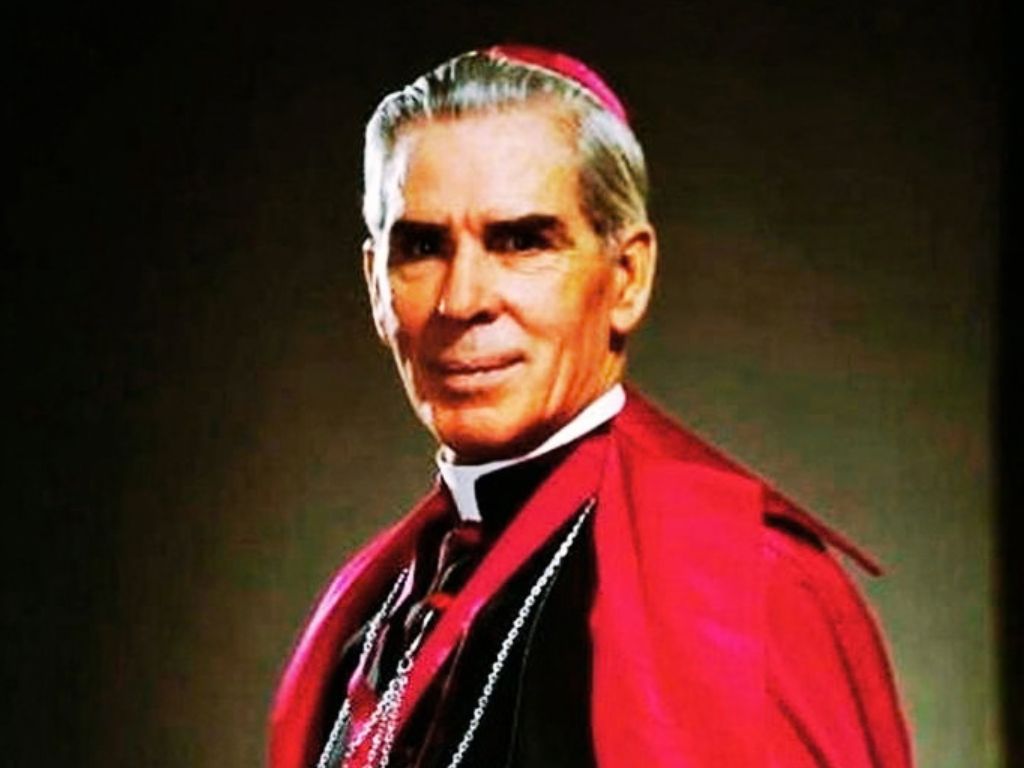
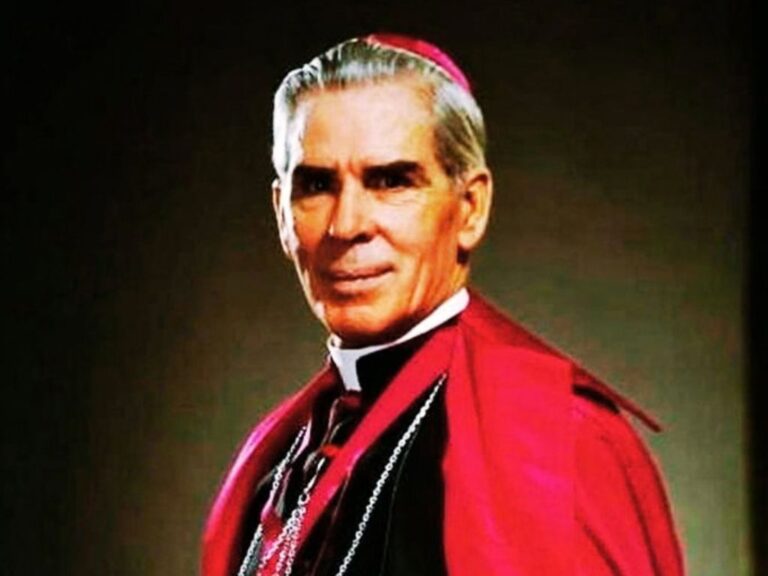
Today, September 24, 2026, the Catholic Church celebrates a beautiful moment in the history of the American Church: the beatification of Archbishop Fulton J. Sheen.
For many Catholics, Archbishop Sheen is already a familiar name. Some may remember his powerful preaching. Others may have discovered him through his books, recordings, television programs, or the many videos of his homilies and reflections that continue to circulate today.
But today, the Church gives us another reason to remember him—not simply as a gifted preacher, teacher, writer, or communicator, but as a man whose life is being formally recognized as an example of Christian holiness.
Archbishop Fulton Sheen is now Blessed Fulton Sheen.
And perhaps this is a good time for us to ask ourselves:
Why does the Church give us saints?
Sometimes we think of saints as people who lived extraordinary lives completely different from ours.
We imagine saints as people who never struggled, never became tired, never experienced disappointment, or never had to deal with the ordinary problems of life.
But the lives of the saints tell us something very different.
They remind us that holiness is possible in the midst of ordinary human life.
Saints were husbands and wives, mothers and fathers, priests and religious, teachers and workers. Some lived quietly and were known by very few people. Others, like Archbishop Sheen, were given a public platform and reached millions.
What united them was not fame.
It was their desire to belong completely to Christ.
That is why the Church does not present saints to us so that we can simply admire them from a distance. She presents them to us as examples to follow.
The Vatican itself explains that the Church preserves the memory of the saints by proposing their lives as examples of holiness and as a way of helping the faithful follow Christ more closely.
One of the things that makes Archbishop Sheen particularly interesting for our time is the way he used modern communication to proclaim the Gospel.
Long before podcasts, YouTube, Facebook, TikTok, and livestreaming, Sheen understood the power of media.
His television program, Life Is Worth Living, brought Catholic teaching into millions of American homes during the 1950s. He had already been active in radio, teaching, writing, and preaching before becoming a bishop.
He understood something important:
The Gospel has to reach people where they are.
The technology may change, but the mission does not.
Today, we have phones instead of television sets. We have YouTube instead of network television. We have podcasts, social media, blogs, livestreams, and countless other ways of communicating.
But the question remains the same:
How are we using the gifts God has given us to bring people closer to Him?
Archbishop Sheen’s example challenges us not merely to consume media, but to consider how we can use whatever gifts and opportunities God has placed in our hands for the proclamation of the Gospel.
There is another important lesson we can learn when we celebrate a beatification.
Catholics do not worship the saints.
We worship God alone.
The saints point us toward God.
When Catholics ask a saint to pray for us, we are not replacing God with that saint. We are asking a member of God’s heavenly family to intercede for us—just as we might ask a friend or family member here on earth to pray for us.
This is particularly meaningful in the case of Blessed Fulton Sheen.
The miracle recognized by the Church involved the survival and recovery of a child after a catastrophic birth situation, following prayers seeking Sheen’s intercession. The Church’s recognition of that miracle was an important step toward his beatification.
But even here, the focus ultimately returns to God.
God is the source of every grace.
The saints simply remind us that God’s grace can transform a human life.
Why do we need saints?
Because the world needs witnesses.
We live in a world filled with noise, confusion, fear, division, and countless competing voices telling us what we should believe and how we should live.
The saints give us another voice.
They say:
You can choose Christ.
You can remain faithful when it is difficult.
You can forgive.
You can pray.
You can serve.
You can begin again after falling.
You can love God in the middle of ordinary life.
And you can use your particular gifts—not for your own glory, but for God’s glory.
Archbishop Sheen’s life is a powerful example of this.
He was gifted with intelligence, eloquence, humor, and an extraordinary ability to communicate. But those gifts were not meant simply to make him famous.
They became instruments of evangelization.
Pope Leo XIV recently highlighted this very aspect of Sheen’s witness, saying that his example and intercession should inspire others to find new ways of spreading the Gospel with joyful enthusiasm.
It is also important to understand what beatification means.
Beatification does not mean that the Church is saying that a person is now a god or that Christians should worship that person.
Rather, it is a formal step in the Church’s process of recognizing holiness.
Blessed Fulton Sheen is now honored publicly as a Blessed, and Catholics may seek his intercession according to the norms of the Church.
Canonization would be a further step.
And perhaps this reminds us of something beautiful:
God’s work in a person’s life does not end when that person dies.
A life offered to Christ can continue to touch souls long after the person has gone home to God.
A sermon can continue to inspire.
A book can continue to teach.
A prayer can continue to bear fruit.
A witness can continue to lead someone back to Christ.
Perhaps the question we should ask today is not simply:
“Was Fulton Sheen a great preacher?”
Instead, we can ask:
What is God asking me to do with the gifts He has given me?
Maybe you have the gift of writing.
Maybe you have the gift of teaching.
Maybe you are good at encouraging people.
Maybe you know how to listen.
Maybe you are a mother raising children in the faith.
Maybe you have a talent for music.
Maybe you work quietly behind the scenes.
Maybe your apostolate is simply the way you treat the people you encounter every day.
Not everyone will stand before a television camera.
Not everyone will write books.
Not everyone will preach to thousands.
But every one of us is called to holiness.
And that is perhaps one of the greatest reasons the Church gives us the saints.
They remind us that holiness is not reserved for a select few.
We are all called to become saints.
When I think about the saints, I think of them as lights along the road.
They do not replace Christ.
They help us see Christ more clearly.
They remind us where we are going.
And when we stumble, they remind us that we can get up again.
Blessed Fulton Sheen spent much of his life speaking about Christ to a world that desperately needed to hear the Gospel.
His beatification invites us to listen again.
Not simply to his words—but to the witness of his life.
And perhaps today, as we celebrate his beatification, we can make a simple prayer:
“Lord, help me become the person You created me to be. Help me use the gifts You have given me for Your glory. And through the prayers of Blessed Fulton Sheen and all the saints, lead me closer to You.”
Because ultimately, that is what the saints are for.
They lead us home to God.
Amen.